
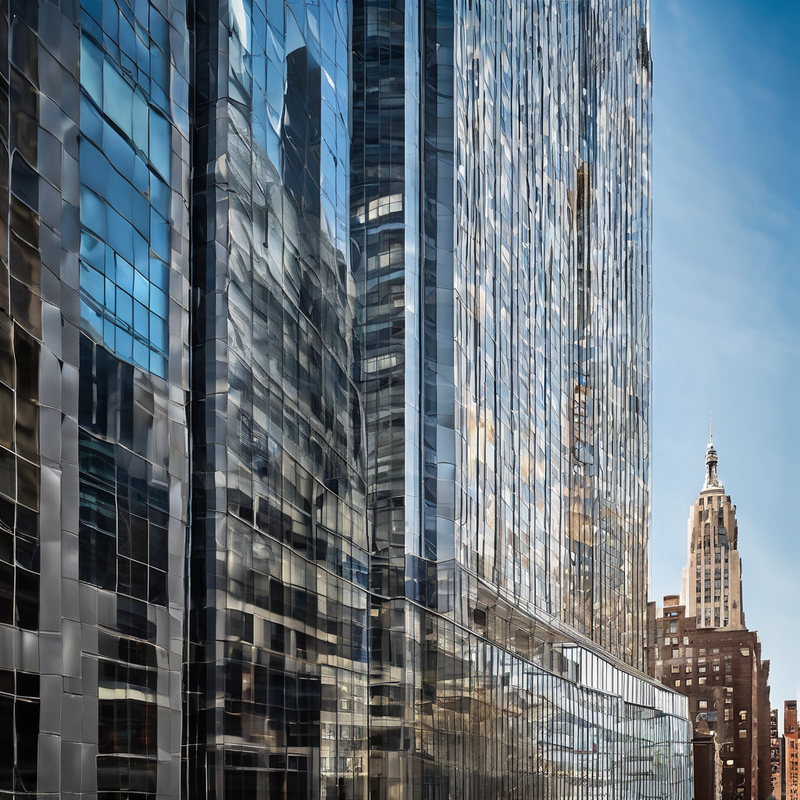
JPMorgan Chase is all in on office. So why is it selling an NYC office building? 🏢🧐
This irony is as thick as the concrete in a high-rise: JPMorgan Chase, a stalwart of Wall Street, has made headlines with its ambitious commitment to office space even as it puts a prime NYC building on the market. One must ask, in a world where hybrid work is the new normal, why is one of the most powerful banks in the nation divesting when it has professed its faith in the enduring value of a physical workplace? 💼
The building in question, a gleaming embodiment of corporate ambition, symbolizes the paradox at the heart of today’s commercial real estate. It serves as a battle standard for a bank that has repeatedly declared that employees are best served when gathered under one roof, yet they are turning their backs on real estate that many would consider invaluable. What gives? 🤔
Chasing After a Shifting Marketplace
Since the pandemic birthed an unexpected shift in workplace dynamics, the concept of “the office” has evolved faster than many could blink. Much like the chrysalis transforming into a butterfly, the traditional office is being redefined. JPMorgan Chase has rightly grasped that physical spaces are not relics of the past, but they are also no longer the exclusive bastions of corporate identity. In fact, amid fervent discussions of workplace rights and flexibility, a glaring antithesis emerges: while Chase vows to invest more in physical workspace—positioning itself as a champion of in-person collaboration—it simultaneously sheds valuable assets. 💭
According to the company, these efforts aim to foster creativity and enhance collaboration. “We believe in the power of in-person interactions,” a spokesperson declared with the conviction of a preacher at a pulpit ⛪. Yet, what does it say about their faith when they are willing to part with a prime piece of real estate, one that could house ‘creativity’ and ‘collaboration’ in abundance?
Evocative Realities: The Numbers Game
Let’s unpack this decision with concrete data. The office market in Manhattan has seen a remarkable pivot, a 22% drop in leasing activity compared to pre-pandemic levels, according to a recent report by CBRE. As demand fluctuates and remote work destroys the one-size-fits-all approach, players in the market find themselves at the crossroads of opportunity and risk. Is this sale a desperate retreat or a strategic repositioning? It’s akin to sailing a ship into a storm while insisting the sun will shine tomorrow. ⛴️
The Great Disruption
Another layer of complexity arises when we analyze employee expectations. The tides of change have ushered in a generation that craves flexibility, autonomy, and a profound work-life balance they refuse to compromise. It’s as if the corporate ladder is being replaced by an intricate maze where employees choose their own paths. Chase may fear that investing heavily in large footprints will soon resemble anchor chains in a flood, dragging them down in an evolving landscape where workers demand the freedom to chart their own journeys. 🌊
Just as the wisp of smoke shifts in a breeze, so too have the workplace environments that foster productivity. As more companies adopt hybrid models, promising a blend of home and office, the question remains: will the shiny, cavernous buildings that once served as battlegrounds for corporate dominance now become mere monuments to a bygone era?
Why Sell? The Strategic Calculation
So, why the sale? Perhaps it is a calculated pivot, allowing JPMorgan Chase to consolidate its resources and focus on refining existing spaces. After all, the act of maintaining vast portfolios of underutilized properties amidst a backdrop of declining demand could prove financially catastrophic—a well-placed bet against a future rife with instability. Transitioning investments to more adaptive models may be the lifeline that keeps the bank competitive. 🔄
By shedding excess weight, Chase may be positioning itself to weather the storm of uncertainty while still standing firm in its advocacy for office use. The fundamental irony lies in their awareness of societal change yet holding tightly to traditional notions of workspace value. Their decision reflects a striking contrast—a dance between the old and the new, amid rhythms set by evolving employee needs, economic pressures, and spatial realities.
The Road Ahead: Daring to Dream
In this world of ever-shifting dynamics, one thing remains clear: the office is not going away, nor is it a singular destination. Instead, it is a kaleidoscope of opportunity waiting to be refracted into countless spectra. JPMorgan Chase must navigate this intricate blend of desires and demands while holding onto the vision of enhanced collaboration.
So the question now stands—can they reconcile their lofty dreams for in-person interaction with the stark realities of a fluid workforce? As we witness their journey unfold, it becomes evident that the future of work is both an art form and a science, dictated not only by algorithms or trends but also by deep human experiences. Let us hope that JPMorgan Chase not only survives this transformative era but thrives, shaping the office not just as a place to work but as an essential, vibrant part of the human landscape. 🌍✨




Why is JPMorgan Chase selling offices if theyre all about the office life? 🤔 Seems contradictory. Whats the real story? 🏢📉
Why would JPMorgan Chase sell an office building if theyre all about office work? 🤔 Seems contradictory, doesnt it? #workrevolution
Whats up with JPMorgan Chase selling offices? Are they on to something or just riding the work revolution wave? 🤔🏢
Wow, JPMorgan Chase selling offices in NYC? 🤔 Are they adapting to the work revolution or making a risky move? #Discuss 🏙️📉
I dont get it, why is JPMorgan Chase selling offices if theyre all about the office life? 🤔 Seems fishy.